
Can one well-designed virtual project truly turn a local class into a global learning lab?
Educators who want to modernize their syllabus can use a single online module to connect students across different countries. These experiences boost collaboration, cultural insight, and real research skills.
The EVOLVE project, launched in 2023, shows how a thoughtful program transforms classroom routines into shared inquiry with partner universities. Careful planning and clear learning outcomes make each project accessible and meaningful.
In this guide you’ll find practical strategies, tools, and design tips to run a successful virtual exchange that improves engagement and academic outcomes. See the DownAppz guide for reviews and tips on selecting the right program: DownAppz guide.
Understanding the Concept of Virtual Exchange
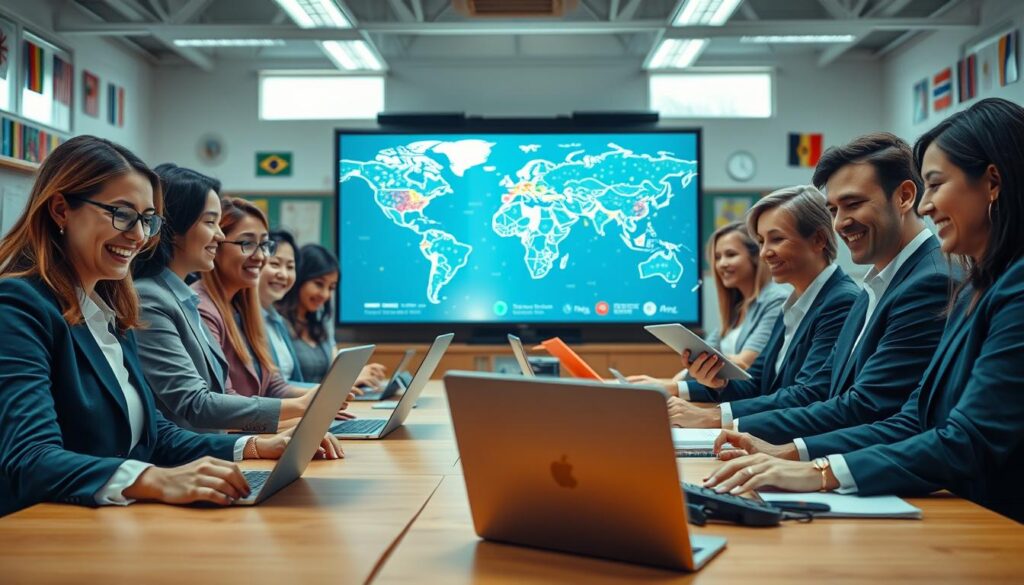
Bringing together learners from multiple universities creates new ways to build knowledge together. The EVOLVE (2023) definition frames a virtual exchange as a sustained, technology-enabled, people-to-people education program. This model emphasizes ongoing contact, not one-off chats.
Defining the practice
Virtual exchange courses pair students from two or more institutions. They use shared outcomes and tools to support joint research and project work. A module may be short, or it may span a semester and become part of the curriculum.
“Co-constructing knowledge is like building an airplane while flying it.”
Pedagogy and design
Good pedagogy provides scaffolding so participants explore culture and communication. Instructors at partner institutions coordinate learning outcomes, assessment, and activities. Technology enables synchronous and asynchronous interaction while keeping academic rigor intact.
| Format | Participant Scale | Coordination Need |
|---|---|---|
| Single module | Small groups | Low–medium |
| Semester course | Large groups across universities | High |
| Research project | Mixed teams | High |
Why Digital Exchange Courses for Teachers Matter
Joining partner programs expands a faculty member’s reach and creates new research visibility.
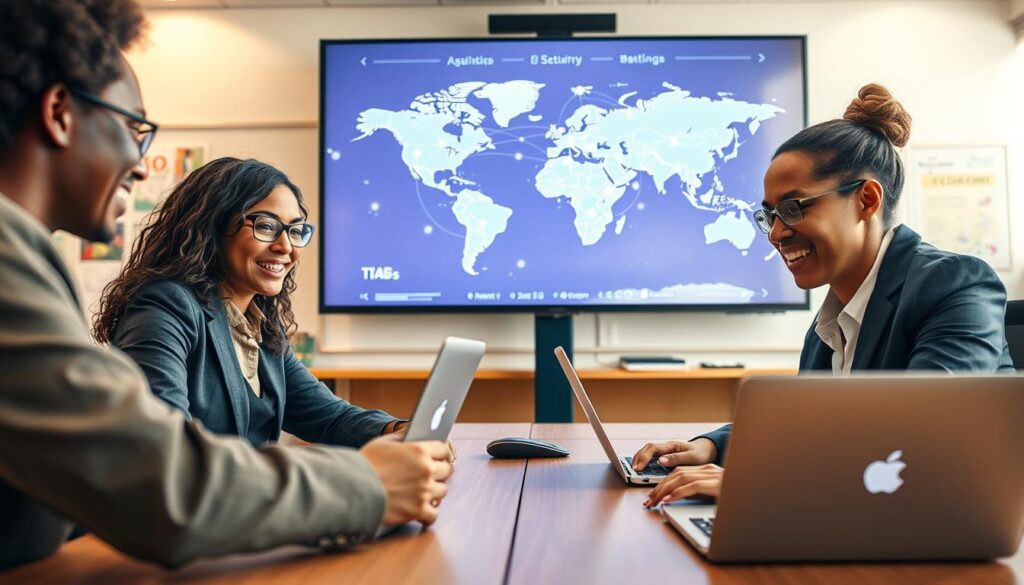
Engaging in a virtual exchange program gives faculty an opportunity to build networks and increase research impact. It helps instructors see their subject with fresh eyes and apply new methods in teaching and learning.
- Faculty gain professional development and deploy practical skills that support career growth.
- These projects encourage interdisciplinary teaching and stronger ties with partners in other countries.
- Participants report higher visibility, more collaboration, and new research ideas.
“Virtual exchanges reshape a teacher’s role into a global facilitator of knowledge.”
Over time, a well-run course multiplies benefits: more students reach, sustained partnerships, and transferable strategies that improve classroom outcomes. These experiences deepen cultural understanding and boost knowledge that lasts beyond a single project.
Core Benefits for Student Learning Outcomes
Structured online partnerships give students fresh reasons to engage with course content. These programs link classroom tasks to real peers and timelines abroad, making learning purposeful and immediate.
Boosting Student Engagement
Research shows students who take a virtual exchange are about twice as likely to study abroad later (Lee et al., 2022). That jump comes from scaffolding and early exposure that build confidence.
Ryan (2020) found virtual exchange helps with language support and motivation. Students gain practice, voice, and the courage to explore other cultures in person.
Working in international groups grows teamwork and communication skills. Projects ask students to negotiate ideas, manage time across countries, and solve real problems together.
These activities spark curiosity and broaden knowledge beyond textbooks. Participants report stronger networks, more development opportunities, and better preparation for global careers.
In short, virtual exchange turns content into connection, and connection into deeper learning.
Developing Intercultural Competence in the Classroom
Building intercultural competence begins when classrooms intentionally scaffold contact between students from different cultural backgrounds.
Courtney Dorroll and Begona Caballero-Garcia (2020) show that virtual exchange creates community and a safe space to explore other cultures. In practice, this means designing a program that makes culture part of every assignment.
Zheng et al. (2022) found that participating in a virtual exchange improves a student’s global mindset. Teachers can pair small groups with partner institutions so participants negotiate norms, roles, and expectations.
Try short activities that prompt reflection: discuss metaphors in everyday speech, map assumptions, and role-play common miscommunications. These tasks build resilience and key communication skills needed for work across countries.
“Intercultural competence grows when learners practice repair, reflection, and respect in real interactions.”
- Use small-group projects to surface cultural differences in teamwork.
- Include assessments that measure development in perspective-taking and adaptability.
- Draw on Berardo & Deardorff (2012) for tested strategies that translate research into classroom practice.
When teaching makes culture explicit, a course becomes a lab for global learning. The goal is graduates who hold knowledge and the skills to collaborate effectively across diverse social landscapes.
Essential Planning Strategies for Educators
Planning a successful virtual exchange starts with a clear, shared roadmap between partner instructors. Early alignment makes the project manageable and meaningful.
Collaborative course design
Co-design prevents one partner from choosing all assignments or tools. Instructors should agree on roles, technology, and assessment up front.
Early coordination
Meet learning designers and technologists early to ensure accessibility and smooth delivery. Discuss platform limits and student access across countries.
Setting learning outcomes
Define clear outcomes that guide teaching, student tasks, and evaluation. Shared goals keep the program aligned and support research and development.
| Planning area | Key action | Benefit |
|---|---|---|
| Design | Co-create syllabus and assignments | Balanced workload, inclusive tasks |
| Tech | Audit tools and access | Equal access for students |
| Logistics | Set meeting cadence and backups | Fewer delays from time zones or issues |
Good planning makes the virtual exchange a core part of the course, not an add-on.
Navigating Cultural Differences in Global Projects
When teams span countries, simple tasks can expose deep cultural assumptions. In COMM 3350, Dr. Melissa Hernandez-Katz and Universidad Icesi used classroom projects to make those assumptions visible.
Students worked in international teams to map scenarios where miscommunication might occur. They created short videos that explained workplace misunderstandings, such as launching a business abroad.
The project used role-play and talk-show styles so each student practiced repair and reflection. Instructors guided discussions to surface bias and to deepen cultural awareness.
- Set clear goals that target intercultural skills and research development.
- Design activities that let students reflect on norms influencing teamwork.
- Use peer review to highlight different interpretations of the same interaction.
By combining real scenarios with structured reflection, a virtual exchange program helps students build the practical skills needed in global workplaces.
Selecting the Right Technology Platforms
Choosing the right communication tools can make or break a cross-border classroom project. Thoughtful platform selection protects equity and keeps students engaged across time zones.
Asynchronous Chat Tools
Asynchronous chat keeps momentum after live sessions end. Tools like Slack and Google Chat let remote students join discussions on their schedule.
Silent Discussion Methods
Google Documents are ideal for “silent discussions.” Students respond to prompts at their own pace and build a visible thread of ideas.
- Ed Discussion sits between formal boards and chat. Faculty can endorse answers and post announcements.
- Pick one or two accessible tools so students in different countries share the same experience.
- Prepare backups—some platforms are blocked in certain locales and can create power imbalances.
Tip: prioritize simplicity and access. When tools match participant needs, the program supports better skills development and deeper learning across partners.
Making Your Virtual Exchange Remote Accessible
Make remote access the default when planning international class activities so every student can join on their own schedule.
Prioritize asynchronous activities and assessments. This helps students who live in different countries or who balance work and family.
Asynchronous work boosts agency. Students can reflect, draft, and respond in thoughtful threads rather than rushing through live chats.
“Hybrid models let learners take part in events like mock congressional hearings and conversations with guest speakers.”
Make expectations and grade rubrics transparent. Clear instructions let remote students show their skills and follow the course path.
- Use discussion boards, recorded briefings, and scaffolded tasks to replace some live sessions.
- Offer multiple ways to demonstrate mastery: video, text, or group artifacts.
- Consult the Sheridan Center (DLD) guide on Remote Accessible Teaching for practical strategies.
| Goal | Strategy | Benefit |
|---|---|---|
| Equity | Asynchronous assessments | All students can participate |
| Engagement | Role-play and recorded debates | Deeper learning across time zones |
| Clarity | Transparent rubrics | Reduced confusion and fair grading |
Lessons from Successful Global Collaborations
Real-world partnerships let students turn theory into tangible benefits for communities.
At UT Dallas, Dr. Elizabeth Searing worked with Dr. Paul Lambert at the University of Stirling to support a Dallas–Fort Worth nonprofit. Students in Financial Management analyzed revenue portfolios while Stirling peers turned that work into clear data visualizations.
The joint project produced usable recommendations for the nonprofit and gave students hands-on experience in an international context. Similar success appears in the Brown in Washington program, where remote teams share ideas via Zoom and build networks across locations.
By studying epidemics in different national settings, Dr. Carol Cirulli Lanham’s groups deepened their grasp of public health policy. These cases show that well-designed collaboration improves research and teaching while expanding student career connections.
Key lessons: set shared goals, pick reliable tools, and commit to mutual adaptation. When partners focus on clear outcomes, a virtual exchange becomes an engine for learning, civic impact, and meaningful global skill development.
Overcoming Common Challenges in Virtual Exchanges
Uneven access to platforms and schedules often creates hidden obstacles in cross-border classroom work. A proactive approach helps prevent one partner from dominating project decisions or tools.
Addressing Power Imbalances
Start by auditing the technology and accounts available across partner institutions. The 2022 Virtual Exchange Impact and Learning Report notes that platforms familiar to only one group can deepen imbalances.
Agree on tools everyone can access and offer low‑bandwidth options. Share roles so no single instructor dictates every assignment.
Make time zones and academic calendars explicit in the syllabus. Build flexibility into deadlines and meeting schedules so students in different countries can participate fairly.
- Open conversations about cultural differences before project work begins.
- Encourage students to share norms and examples from their communities.
- Design assessments that value collaboration, not just individual output.
“Transparent planning and mutual respect turn logistical challenges into learning moments.”
When partners commit to true collaboration, the program strengthens students’ problem-solving skills and helps the course meet its learning goals.
Integrating Research and Data into Your Course Design
Pairing statistical tasks with international peers turns data cleaning into a lesson in collaboration. In Dr. Octavious Smiley’s Introduction to Data Science course, mixed teams from UT Dallas and Universidad Iberoamericana analyze real datasets. Students clean, explore, and interpret data and present findings in a final video.
This project-based approach helps students build applied statistics and probability skills. It also strengthens intercultural teamwork and communication. Working with partners abroad shows how different groups approach problem-solving and analysis.
Integrate visualization and storytelling into assignments so technical results become usable insight. The UT Dallas–University of Stirling collaboration shows how clear visual work links financial analysis to practical outcomes.
Design tips: use public datasets, scaffold analysis steps, require a shared report and a short video presentation. Ground tasks in research methods so the program supports rigorous inquiry and real-world impact.
These research-led projects build critical thinking and data literacy. They prepare students to apply analytic skills across borders and disciplines while contributing to broader academic discussion.
Professional Development Opportunities for Teachers
Access to funded training builds educators’ confidence in running global projects. The US‑UK Fulbright Global Challenges Teaching Award combines training, mentorship, and a generous stipend to teach best practices in virtual exchange.
Many institutions also support staff through Centers for Teaching and Learning. These centers share guides, newsletters, and chance to meet peers who lead virtual programs.
At UT Dallas, 101 virtual exchange initiatives since 2021 show rapid growth. Participation helps teachers gain new pedagogical skills and international experience without leaving campus.
- Benefits: funding, networks, and improved reputation through prestigious awards.
- Alumni communities offer long-term collaboration and project ideas that boost student engagement.
- Centers and fellowships make it easier to scale a single program into sustained partnerships.
| Opportunity | Benefit | Example |
|---|---|---|
| Fulbright Global Challenges | Training + funding | Design virtual exchange modules |
| Center support | Resources & networking | Workshops and guides |
| Alumni groups | Sustained partnerships | Co‑teaching and research |
Future Trends in Global Classroom Connectivity
The next wave of global classrooms centers on machine learning projects that combine technical and social insight.
AI will let students prototype computer-vision tools and lightweight diagnostics across campuses. Dr. Ben Porter’s Roboflow project links UT Dallas and Universidad Iberoamericana teams to train models on diverse datasets.
These shared labs build technical skills while exposing learners to cultural differences that shape data and use cases. As platforms improve, virtual exchange will scale to include more partners and richer tasks.
| Trend | Impact | Example |
|---|---|---|
| AI collaboration | Faster model training with varied data | Roboflow computer-vision projects |
| Interdisciplinary work | Broader problem solving | CS + public health + sociology |
| Real-time tools | Better cross-language teamwork | Live translation & annotation |
“Scalable AI labs will make it possible for more students to tackle real problems with global peers.”
Educators must stay adaptable, updating a program to include these tools and to support equitable participation. The future promises more immersive, collaborative learning that prepares students for a fast-changing world.
Conclusion
Thoughtful global projects turn coursework into real-world practice that students carry beyond graduation. These initiatives build intercultural skills, strengthen research ties, and expand classroom reach.
Careful planning, shared goals, and the right tools make partnership work. True collaboration keeps power balanced and learning meaningful.
Educators who try an exchange module can lift student engagement and career readiness. Seek training, partner with international programs, and test low‑bandwidth options to include every learner.
With continued research and new technologies, these programs will grow. The effort yields deep rewards in student growth and faculty development.