
Can a single online program truly replace the push of studying abroad and reshape how students connect across the globe?
The EVOLVE project (2023) defines virtual exchange as sustained, technology-enabled people-to-people learning that builds real ties. These programs give students scaffolding to try study abroad and other immersive experiences without leaving campus.
Good exchanges blend strong teaching and thoughtful design so every student feels part of a global classroom. Instructors craft activities that spark dialogue, boost skills, and make the experience feel meaningful.
This guide shows how the best virtual exchange programs open opportunities once limited by travel costs. Visit DownAppz guides to find curated reviews and practical tips for choosing a course and preparing for global study.
Understanding Digital Exchange Courses with Live Classes
Remote, synchronous study brings peers from multiple nations into one real-time learning space.
Virtual exchange is defined by the EVOLVE project as a sustained, technology-enabled, people-to-people education program that links geographically separated groups.
One clear example is Brown University’s IAPA1404. That course let students join lectures via Zoom alongside peers in India. Instructors used video and scheduled sessions to handle time differences and cultural context.

How live sessions shape the classroom
Live interaction turns passive viewing into active participation. Students ask questions, share perspectives, and work in small groups. This kind of exchange reshapes how students plan for studying abroad and opens new opportunities for study across countries.
| Feature | Definition | Role |
|---|---|---|
| Model | People-to-people programs | Connects universities and participants |
| Example | Brown IAPA1404 | Demonstrates synchronized lectures via video |
| Benefits | Cross-cultural communication | Builds skills for study abroad and global work |
Key Benefits for Students and Educators
Participating in a virtual exchange often accelerates a student’s path toward studying abroad. Research shows students who take a virtual exchange are roughly twice as likely to study abroad later. That makes these programs a practical stepping stone for many campuses.
At Georgia State University, 3,031 students joined virtual exchange programs in 2024–2025. This number highlights growing interest in global learning and the demand for structured international experiences.
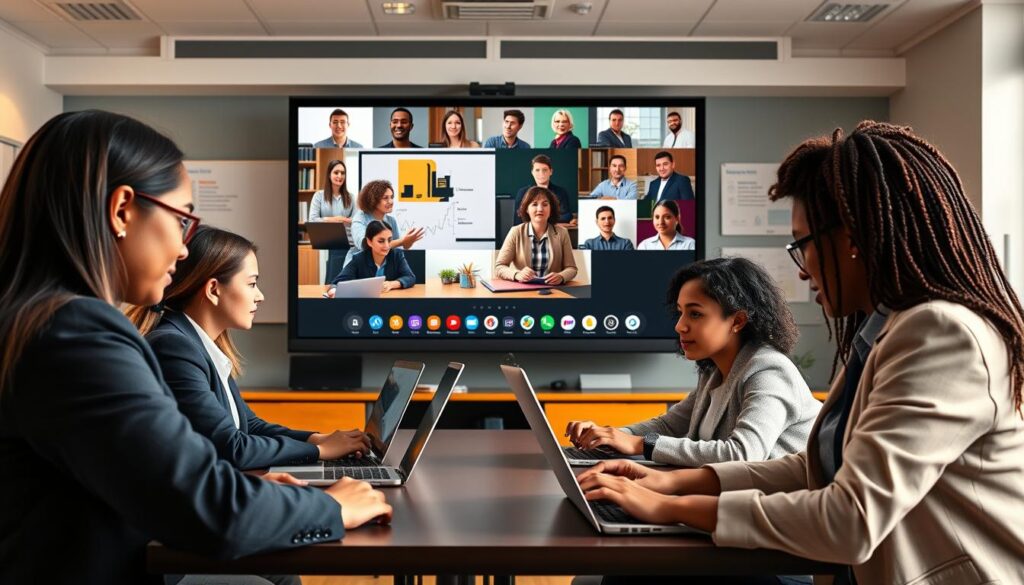
These exchanges help students build intercultural competence and language skills. Students work in a group with peers from other countries, which strengthens relationships and confidence.
- Students gain real-world skills for study and work around the world.
- Instructors find new research ties and interdisciplinary teaching chances.
- Technology makes collaboration across time zones practical and reliable.
| Benefit | For Students | For Educators |
|---|---|---|
| Study abroad readiness | Twice as likely to pursue study abroad | Stronger study-abroad pipelines |
| Intercultural skills | Better communication and cultural awareness | New classroom perspectives and research partners |
| Practical collaboration | Work with peers across countries | Design interdisciplinary group projects |
In short, virtual exchanges expand opportunities for students and educators alike. They create a clear way to practice global learning before or instead of studying abroad.
Essential Technology Tools for Virtual Collaboration
The right platforms keep participants across countries working smoothly. They set the tone for participation, project work, and peer feedback in a virtual exchange.
Asynchronous Chat Tools
Asynchronous chat like Slack or Google Chat helps students continue conversation after a class. These tools let groups share quick questions, files, and updates on group work.
They sustain communication and build relationships among peers who cannot meet at the same time.
Collaborative Document Platforms
Google Documents are ideal for “silent discussions” where students respond to prompts in real time or later.
They let instructors track edits, give feedback, and keep a living record of group contributions.
Discussion Forums
Tools such as Ed Discussion let instructors endorse answers and post announcements. That keeps accurate information visible to every student.
Forums bridge formal instruction and informal peer support.
| Tool Type | Primary Use | Benefit | Example |
|---|---|---|---|
| Chat | Ongoing group messages | Fast coordination, relationship building | Slack, Google Chat |
| Collaborative Docs | Shared writing and silent discussion | Asynchronous contribution and feedback | Google Documents |
| Forums | Threaded Q&A and announcements | Curated answers and instructor endorsement | Ed Discussion |
Accessibility matters: instructors must pick tools that all participants can use, regardless of country or connection speed.
Strategies for Designing Successful Virtual Exchange Programs
Effective program design starts before the first meeting and centers on shared goals among partner universities.
Instructors should meet early with learning designers to map accessibility, assessment, and time-zone logistics. Watson Professor Brian Atwood’s diplomacy course is a clear example: he used Zoom to link students in Washington, D.C., Providence, and Berlin for joint simulations.
Design collaboratively: avoid a single instructor deciding all assignments. Let partner universities co-create tasks so students from different countries feel equally represented.
- Plan intercultural competency training to reduce miscommunication.
- Use small-group work while setting norms for participation across cultures.
- Choose tools available to all participants to prevent power imbalances.
- Build real-world projects—mock hearings or joint research—to deepen the experience.
- Coordinate schedules so peers can meet at fair times.
| Task | Responsible | Purpose |
|---|---|---|
| Syllabus design | Instructors + designers | Fair, accessible work |
| Technology check | IT teams | Equal access for participants |
| Intercultural prep | Lead faculty | Stronger group communication |
Overcoming Common Challenges in Remote Learning
Cross-cultural friction is common in remote classrooms, but clear design can turn it into learning fuel. Instructors who name common pitfalls make it safer for students to speak up.
Navigating Cultural Differences
Start with low-stakes meet-and-greets. Wright et al. (2024) used Telegram so students in Atlanta and Hong Kong could introduce themselves before synchronous sessions.
Use short video intros to build trust. Seeing peers helps a group feel like a class, not a list of names.
Teach about metaphors and everyday phrases. Instructors can show how language lacks context and how that causes confusion.
Plan for unequal tech access. Offer offline options, flexible deadlines, and clear communication norms so participants in different countries can contribute fairly.
| Challenge | Practical Step | Benefit |
|---|---|---|
| Communication style | Set discussion norms | Clear expectations |
| Tech gaps | Provide async alternatives | Inclusive participation |
| Group roles | Assign tasks early | Balanced contribution |
Addressing these issues openly helps virtual exchange programs stay positive and teaches students how to work across cultures—an essential skill for study abroad and global careers.
Boosting Your Career with Global Competencies
Hands-on international projects help students turn classroom theory into career-ready skills.
Participating in a virtual exchange gives students proven practice in teamwork, cross-cultural communication, and remote project management. Employers value the ability to coordinate across time zones and handle varied workflows.
Badges or certificates from these programs signal real-world experience on a resume. Instructors can help students frame achievements as measurable skills—project leadership, conflict resolution, and clear written reports.
The program also expands a student’s professional network. Peers and faculty from other countries become contacts for future work or study abroad opportunities.
In short, virtual exchanges strengthen a student’s global mindset and make candidates more competitive for jobs that require teamwork across borders. For careers in global business, research, or nonprofit work, this experience is a clear advantage.
The Future of International Education and Hybrid Models
A growing trend ties remote group work to short study abroad visits, forming a richer international learning arc.
Hybrid models pair virtual exchange sessions with targeted in-person trips. This blend helps students form relationships online before meeting face-to-face. Those early connections make time abroad more productive and less stressful.
As technology improves, more students around the world gain access to programs that connect peers and faculty from different countries.
Universities can integrate online and on-site parts to broaden access. That reduces cost barriers and brings global education to people who could not travel before.
These models help students build practical skills and deeper empathy. The combination of remote collaboration and short-term study abroad prepares graduates for teamwork around the world.
In time, hybrid programs will reshape how we define education by making global experiences part of routine study rather than a rare option.
Conclusion
Virtual programs make global learning possible for every student, not just those who can travel.
They offer a practical way to gain intercultural experience and to join a course that builds teamwork and communication skills.
When universities embed these programs into the curriculum, each student can benefit from international study without leaving campus.
The skills learned—project management, cross-cultural communication, and applied study—boost education outcomes and support future career success.
Explore program options at your institution to turn classroom work into meaningful study abroad pathways and lasting professional ties.